A Major Success: Automated Testing Is Working
RZP now has working automated testing: the automation opens forms, fills in test data, verifies results, and generates a readable report.
Summary for Non-Technical Readers
The HAIFA team has reached a major milestone: automated testing is working in RZP. The automation can run scenarios, open forms, fill them with test data, and then verify whether the application responds correctly.
This is a significant step for the ERP migration. As more functionality is added to the new version of RZP, it becomes increasingly important to check quickly that nothing has broken. Manual testing remains important, but in a large system it is not enough on its own. Automated tests give the team a way to repeat the same checks and catch defects faster.
Special recognition goes to both members of the HAIFA QA team, Michaela Žočková and Iva Holečková. Their work shows that quality in the project is not only a final inspection step, but is becoming part of development itself.
What the Automation Does
Automated testing in RZP no longer verifies only isolated technical parts. The demo shows work at the user interface level: the automation opens forms, goes through application scenarios, fills in test values, and checks the results.
That is especially important in a migrated application. It is not enough to know that a class or method passes a unit test. Users work with forms, dialogs, buttons, and data. Automated testing therefore has to gradually cover what happens directly inside the application as well.
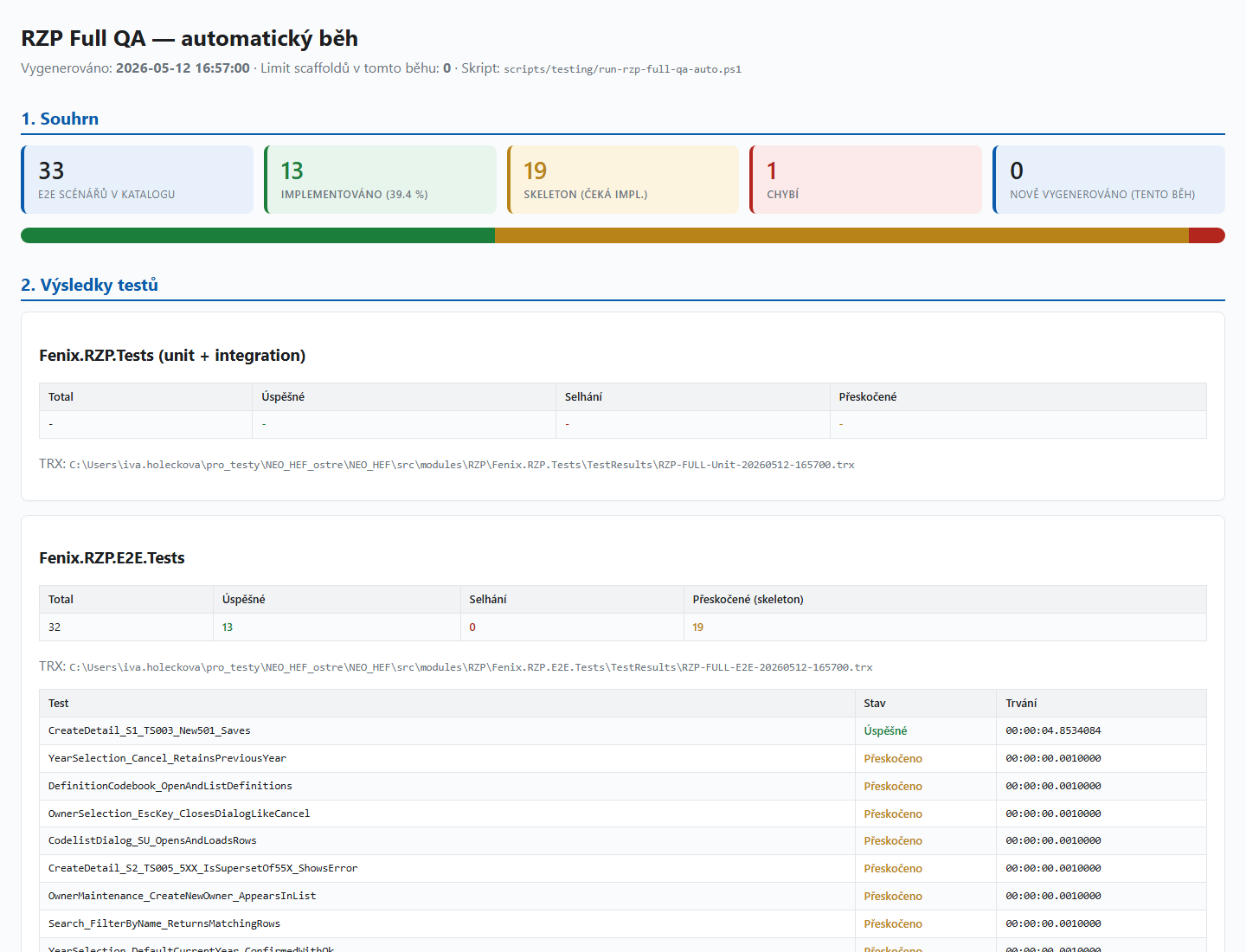
The solution also includes a report from the test run. It clearly shows the scenario catalog, implementation status, and results of concrete tests. The team therefore has not only the tests themselves, but also a readable output for tracking quality.
Why It Matters
Automated testing makes it possible to build the migration on a much firmer foundation. Every new piece of RZP functionality introduces another regression risk: something starts working, but a later change can break a part that already worked before.
Automated tests reduce that risk. They allow the same checks to be repeated regularly, results to be compared, and coverage to be gradually expanded with more scenarios. For a project that is moving an old ERP system into a new technology environment, this is one of the key prerequisites for a sustainable long-term approach.
Beyond the HAIFA Team
This success also matters beyond NEO_HEF itself. The know-how now being built by the HAIFA QA team may be useful in other projects as well. A natural candidate is the Krypton team, which develops, maintains, and operates the legacy Fenix.
If the RZP approach can be generalized and transferred further, this will not be just one successful testing scenario. It can become a practical way to automatically verify parts of the system that have long depended mainly on manual testing and the knowledge of specific people.